
How a Transfer Actually Works: From First Contact to Announcement
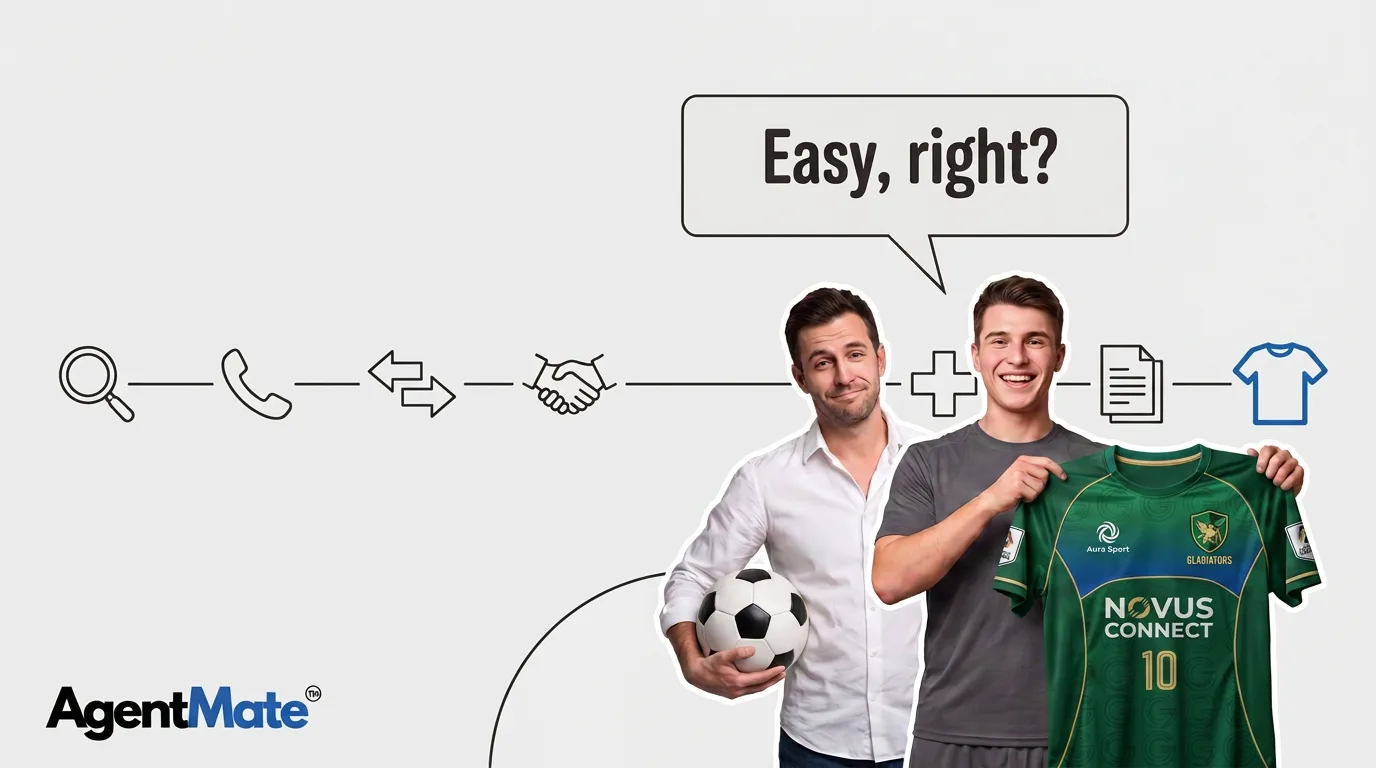
Everyone sees the announcement video. The player holds up the shirt, the fans celebrate, the fee makes the headlines. What nobody sees is the months of work that got the deal there.
A single transfer involves scouts, agents, sporting directors, lawyers, medical teams, and at least two national football associations. It can take months to complete and collapse at any stage. Understanding how the process works is fundamental knowledge for any agent.
Step 1: Identification
Every transfer starts with a need. A club loses a striker to injury, sells a midfielder, or identifies a tactical gap the manager wants filled. The sporting director briefs the scouting department, and the search begins.
Modern recruitment runs on data. Clubs maintain databases of thousands of players across leagues, age groups, and positions. Scouts cross-reference performance metrics with video analysis and live observation before producing a shortlist. For every player who eventually transfers, hundreds were evaluated and rejected (The Ball Business).
This is also where agents enter the picture. An agent who knows a club is looking for a left-back can proactively offer a client who fits the profile. The best agents monitor squad needs across multiple clubs and position their players before any formal enquiry is made.
Step 2: First Contact
Once a club decides to pursue a target, the buying club's sporting director or CEO contacts the selling club to express interest and gauge availability. This must be club-to-club. Approaching the player directly without the selling club's permission is "tapping up," a breach of regulations that can result in fines, transfer bans, or both.
There is one exception: clubs can speak to a player who has six months or less remaining on their contract, with a view to signing them on a free transfer.
Behind the scenes, agents are already active. An agent representing the player will have a good sense of which clubs are interested, what fee the selling club expects, and whether the player is open to the move.
Step 3: Fee Negotiation
If the selling club is willing to negotiate, the financial discussion begins. This is rarely a single number. A modern transfer fee is structured from several components:
Guaranteed fee
, often paid in instalments over two to four years
Performance add-ons
, triggered by appearances, goals, or team achievements
Sell-on clause
, giving the selling club a percentage of any future transfer fee (typically 10–20%)
Solidarity contributions
, a mandatory 5% of the fee distributed to the clubs that trained the player between the ages of 12 and 23, as required by
A headline fee of £30 million might actually be £20 million guaranteed, plus £10 million in add-ons based on appearances and Champions League qualification. This lets buying clubs manage risk and selling clubs benefit from upside.
Contract length matters enormously. A player with five years remaining on their deal commands close to full market value. One year remaining drops that to roughly 30%. An expired contract means zero, and the player signs as a free agent (Football Transfer News).
Step 4: Personal Terms
Fee agreement between the clubs does not complete the deal. The player must separately agree personal terms with the buying club. These negotiations are handled by the player's agent and cover salary, contract length, signing-on fee, performance bonuses, image rights arrangements, and release clause (where applicable).
This is one of the stages where deals can stall or collapse. The two clubs may agree on a £25 million fee, but if the player's wage demands exceed the buying club's structure, or if the contract length doesn't suit either party, the transfer goes nowhere.
The player will also typically speak directly with the manager about playing time and tactical role, a conversation that carries real weight when choosing between multiple offers.
Step 5: The Medical
Once personal terms are agreed in principle, the player travels to the buying club for a medical examination. This is far more than a routine check-up.
Club medical teams conduct orthopaedic evaluations, cardiac screenings, blood tests, MRI scans, and detailed reviews of the player's injury history (The Ball Business). Some clubs bring in external specialists. The process typically takes one to two days.
Failed medicals are rare, but they do happen, and they can kill deals at the final hurdle. Manchester United agreed a £19 million fee for Ruud van Nistelrooy in 2000, only for knee ligament concerns to surface during the medical. The deal was delayed by a full year. More recently, Brentford's £31.5 million move for Antonio Nusa collapsed in 2024 after checks uncovered knee and back issues (SportBible).
A failed medical doesn't always end negotiations. Sometimes it leads to a renegotiated fee or performance-based payment structures that account for the identified risk.
Step 6: Contract and Registration
With the medical cleared, the legal work begins in earnest. Club lawyers draft and finalise:
The transfer agreement
between the two clubs (fee, payment schedule, clauses)
The employment contract
between the player and buying club (salary, bonuses, length)
Agent service agreements
documenting agent commissions
Image rights documentation
, where applicable
For international transfers, both clubs must enter the transaction details into FIFA's Transfer Matching System (TMS). Each club independently inputs over 30 data points, including financial details, agent commissions, and solidarity contributions. The data must match exactly for the system to validate the transfer.
The buying club then requests an International Transfer Certificate (ITC) from the player's former national association, confirming the player's registration has been properly terminated and there are no outstanding contractual issues. The former association has a set window to respond before the new association can register the player.
In England, non-domestic players also require a Governing Body Endorsement (GBE) under the points-based work permit system.
Step 7: Announcement
Only after the medical is passed, contracts are signed, and registration is confirmed does the transfer become official. The announcement, the shirt reveal, the social media video, comes at the very end.
Behind the scenes, player liaison officers are already arranging housing, schooling, and logistics to support the player's transition.
Where It All Goes Wrong
Transfers can collapse at any stage, and often do:
Fee disagreement
: the clubs can't find a number that works for both
Personal terms
: the player's wage expectations exceed the buying club's budget
Failed medical
: an undisclosed or newly discovered injury changes the risk profile
Competing offers
: another club enters late and the player changes direction
Deadline pressure
: in the Premier League, clubs can submit a
between 9 and 11 PM on deadline day to extend paperwork completion until 1 AM, but even this safety net doesn't always save deals
The Agent's Role Through It All
An agent is involved at almost every stage: positioning the player for a move months before any approach, managing communication between all parties, negotiating personal terms, and ensuring their client understands every clause in the contract.
The best agents also know when to walk away. Protecting a client from a bad move is as valuable as securing a good one.
Want to understand how agent commissions work inside these deals? Read How Much Money Do Football Agents Actually Make? For what happens when the clock runs out on all of this, see The Greatest Deadline Day Stories in Football.